

B2b Customer Service: The Complete Guide for 2026
Key takeaway: B2B customer service differs from B2C because you are supporting entire organizations with complex needs and high-value relationships. Getting it right means longer retention, bigger contracts, and referrals that compound over years.
B2B customer service is the practice of supporting business customers who purchase your product or service for their organization. Unlike B2C, where you handle individual consumers with relatively simple needs. B2B support involves multiple stakeholders. longer resolution timelines. and account relationships worth tens of thousands to millions of dollars annually.
| Factor | B2B Customer Service | B2C Customer Service |
|---|---|---|
| Ticket value | High (multi-thousand dollar accounts) | Low (individual purchases) |
| Decision makers | 3-7 stakeholders per account | 1 person |
| Resolution time | Hours to days | Minutes to hours |
| Relationship length | Years | Transactional |
| Customization | Expected | Rare |
| Communication channels | Email, Slack, dedicated portals | Chat, social, phone |
| Escalation complexity | Multiple tiers, account management | Standard queue |
Evidence block: According to Gartner's 2024 B2B Buying Report, 77% of B2B buyers rated their last purchase experience as extremely complex. This complexity extends directly into post-sale support expectations.
The B2B support function has evolved from cost center to growth lever. Companies like Stripe and Datadog have built reputations partly on support quality. Their customers pay premium prices and stay for years because getting help feels easy.
What Is B2B Customer Service?
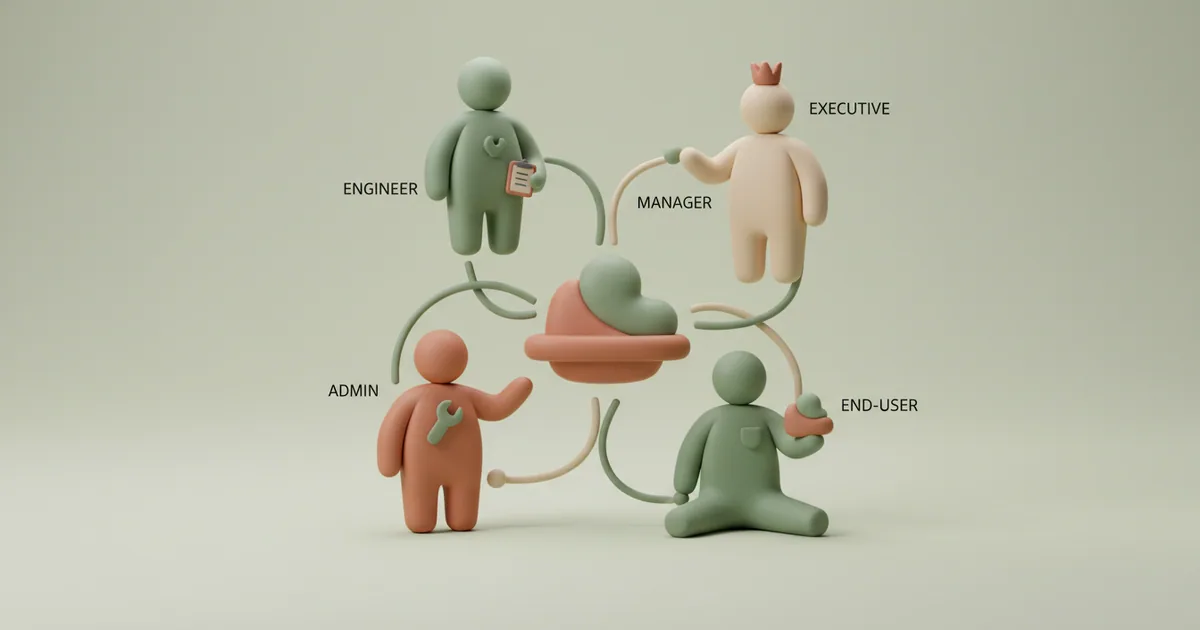
B2B customer service is the entire support ecosystem you build to help other businesses succeed with your product. This includes reactive support (answering tickets, fixing bugs. troubleshooting issues) and proactive support (onboarding. training. health monitoring. success planning).
A B2B customer is not a single person. It is a web of users, admins. decision-makers. and executives who interact with your product differently. Your support team might handle a technical question from an engineer at 9am, a billing dispute from procurement at noon. and a strategic review with the VP of Operations at 3pm. Same account. Three completely different conversations.
The relationship model changes the math entirely. When a consumer churns from Netflix, the company loses $15/month. When a B2B account churns from your SaaS platform, you might lose $50.000/year plus the three referrals they would have generated.
B2B support operates on different timelines. A B2C support ticket might have a 24-hour SLA that feels generous. A B2B enterprise customer expects a response within an hour for critical issues. Some contracts specify 15-minute response times with financial penalties for misses.
The technical depth required is another differentiator. B2B customers integrate your product with other systems. They use APIs. They have security requirements and compliance obligations. Your support team needs to understand not just your product but how it fits into complex enterprise architectures.
Channel preferences skew toward asynchronous, written communication. Email remains dominant. Slack Connect channels are increasingly common for high-value accounts. Dedicated support portals where customers can track tickets and access documentation are expected at mid-market and above.
The feedback loop is more direct and consequential. When a B2B customer requests a feature, they often represent a contract worth protecting. Smart companies build systems to capture this feedback, route it to product teams. and close the loop when features ship.
B2B Customer Service: Best Practices

Dedicated account ownership. Every B2B account above a certain value threshold should have a named person responsible for their success. This does not mean that person handles every ticket. It means someone is accountable for the overall relationship. A common starting point is accounts paying $10,000/year or more.
Segment your support tiers explicitly. A customer paying $500/month and a customer paying $50,000/month have different needs. Build your support tiers around revenue, strategic value. or contract terms. Document what each tier includes. Train your team to deliver consistently.
Invest in onboarding like it is part of support. Most B2B churn happens in the first 90 days. Customers who never fully implement your product cannot get value from it. Your support team should be involved in onboarding. The goal is to get customers to their first moment of value as fast as possible.
Build a knowledge base that actually helps. Most B2B knowledge bases are graveyards of outdated articles. If you are going to have documentation, commit to keeping it current. Assign ownership. Review articles quarterly. Kill the ones that do not perform.
Create escalation paths that work. B2B issues often require input from engineering, product. or leadership. Your support team needs clear escalation paths with defined SLAs at each stage. Ambiguity kills response time and damages trust.
Measure the metrics that matter. First response time is table stakes. Track resolution time, customer effort score. and account health indicators. Monitor how support interactions correlate with renewal rates and expansion revenue.
Use feedback to drive product decisions. B2B customers give you detailed feedback about what they need. Most companies lose this information in ticket systems and email threads. Build a process to capture feature requests, tag them by account value. and surface patterns to your product team.
Empower your support team to make decisions. B2B support requires judgment calls. If your support reps have to ask permission for every decision, response times suffer. Set clear boundaries, then trust your team to operate within them.
Founder's Opinion
The single highest-use investment in B2B customer service is building a direct connection between support feedback and your product roadmap.
Your support team talks to customers every day. They hear the same requests over and over. They see which workarounds customers use when your product falls short. They know which competitors get mentioned in churn conversations. This information is gold for product teams, but it usually gets lost.
The fix is structural. You need a system that captures feature requests from support tickets, attributes them to accounts (so you know the revenue at stake). and surfaces patterns to product managers. When product ships a requested feature, the system should notify the customers who asked for it.
Most companies try to do this manually. It does not scale. A support rep handling 30 tickets a day cannot also maintain a spreadsheet of feature requests and remember to email customers when things ship. You need tooling that automates the capture and notification parts.
The payoff is measurable. Customers who see their feedback implemented renew at higher rates. They expand their contracts. They refer other customers. The feedback loop becomes a retention engine.
I would prioritize this over almost any other support investment. Better ticketing software helps. More headcount helps. But connecting support to product creates compounding value that other investments do not.
Frequently Asked Questions
What is the difference between B2B customer service and B2B customer success?
Customer service is reactive. It responds when customers reach out with problems. Customer success is proactive. It monitors account health, conducts regular check-ins. and works to expand the relationship. Many companies combine them for smaller accounts and separate them for enterprise customers. The key distinction is who initiates contact.
How do you measure B2B customer service quality?
Start with response time and resolution time. Add customer satisfaction scores (CSAT) collected after ticket resolution. Track customer effort score (CES) to understand how hard customers work to get help. For strategic measurement, correlate support interactions with retention and expansion. Accounts that have positive support experiences should renew and grow at higher rates.
How many support reps do B2B companies need per customer?
A general benchmark for SaaS companies is one support rep per 200-400 accounts at SMB scale. Enterprise accounts often require dedicated support with ratios as low as 1:20 or even 1:10 for strategic customers. Track tickets per rep and resolution time. If both are climbing, you need more capacity.
Should B2B companies offer 24/7 support?
Global enterprise customers often require 24/7 coverage for critical issues. This is typically specified in contracts with financial penalties for SLA misses. Smaller customers rarely need round-the-clock support. A common approach is tiered support hours. Premium tiers get 24/7 coverage. Standard tiers get business hours support with emergency escalation paths for true outages.
How do you handle feature requests in B2B support?
Capture every feature request in a structured system that tracks the requesting account, the revenue at stake. and the use case. Review requests regularly with product management. Prioritize based on frequency, revenue impact. and strategic fit. When you ship a requested feature, notify the customers who asked for it. Companies that do this well see measurable improvements in retention and customer advocacy.