
Manual health scoring is not “ops work.” It is silent data corruption. One CSV export later, your retention plan is based on stale events, missing seats, and vibes. Customer success tools in 2026 live or die on three things: usage telemetry, feedback capture, and retention actions that run on time. Chapter 1 covers Gainsight because enterprise churn is usually a contract problem plus bad instrumentation, and you need health scores tied to real product data. Chapter 2 covers ChurnZero because mid-market teams win on real-time signals, not quarterly deck archaeology. Chapter 3 covers Vitally because unified views and predictive risk only matter when identities and events are clean. Chapter 4 covers Userpilot because adoption fixes retention faster than yet another “QBR template.” Every chapter ties back to tracking usage, feedback, and retention without turning into a Jira-style graveyard.
Gainsight in Enterprise CS: Health Scores, Predictive Churn, and the Adoption Work That Drives Retention
If your CS team can’t trust health scores, they stop using them. Then the “retention platform” becomes a dashboard nobody checks until renewal week.
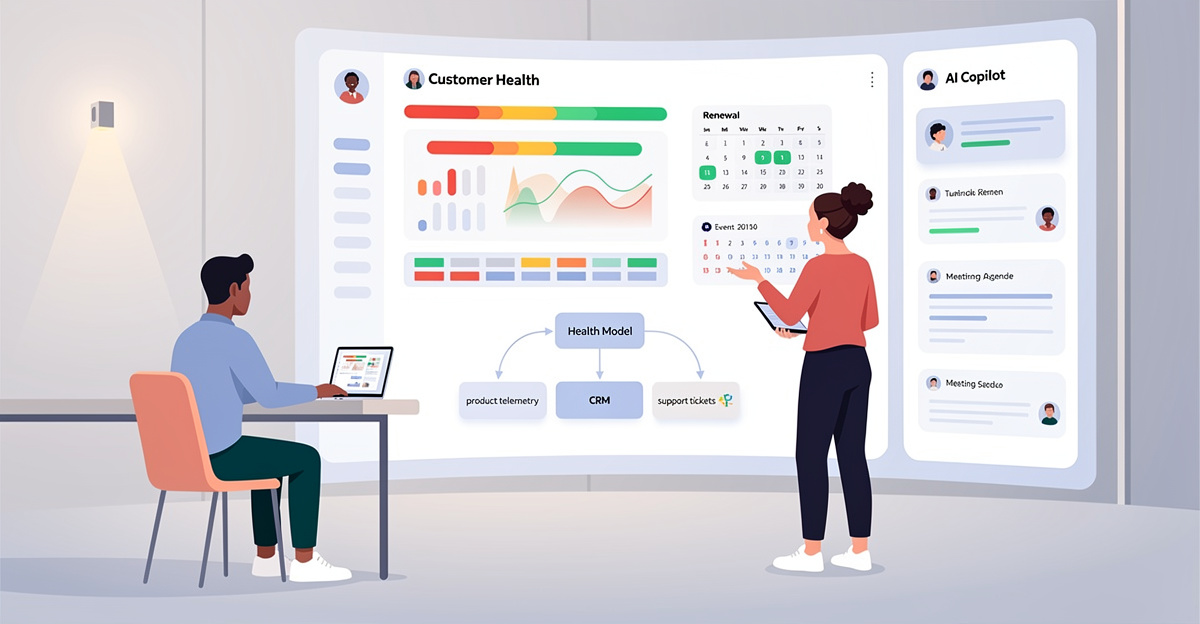
Gainsight is still the market reference for enterprise customer success because it can run 360° customer health monitoring at scale, with customizable health scoring and predictive churn analytics tied to retention outcomes. The core workflow lives in Accounts Explorer, where teams can review account-level product usage and engagement patterns, then filter for at-risk accounts based on configurable scoring logic. The retention win comes from turning those signals into interventions, not from staring at charts. Case studies point to meaningful churn improvement after full deployment, but the same pattern shows up repeatedly: results depend on adoption, data quality, and whether teams operationalize save plays beyond the dashboard.
Gainsight’s predictive churn analytics is the piece enterprises buy to get ahead of churn, not just explain it. It’s designed to surface which accounts need attention and why, early enough to act. Gainsight has also added AI-generated health summaries in 2026 updates. That feature is now common in mid-market tools too. The difference in enterprise rollouts is execution: deployments that keep humans at the center of change management are the ones that work.
Implementation is not light. Research points to 8–12 weeks and dedicated resources. Gainsight is known for complexity, and enterprises often need a CS operations team to run it. As the gap narrows with Vitally and ChurnZero offering similar AI-driven capabilities with lower complexity, Gainsight makes most sense when you can staff the operating model.
How Feedvote solves this Feedvote makes the retention workflow real by tying customer feedback to execution, not just reporting. You capture requests, dedupe them, and keep the signal clean so health narratives aren’t built on noise. Then you push the right items into delivery workflows without extra admin. Start with a feedback system that closes the loop, like this guide on how to close the feedback loop and drive action, and Gainsight becomes easier to operationalize.
ChurnZero for Mid-Market SaaS CS in 2026: Real-Time Churn Signals Before the Renewal Fire Drill
You don’t lose mid-market accounts in one day. You lose them after weeks of small drop-offs that nobody sees in time. By the time the cancellation email hits, your “save” motion is just a discount.
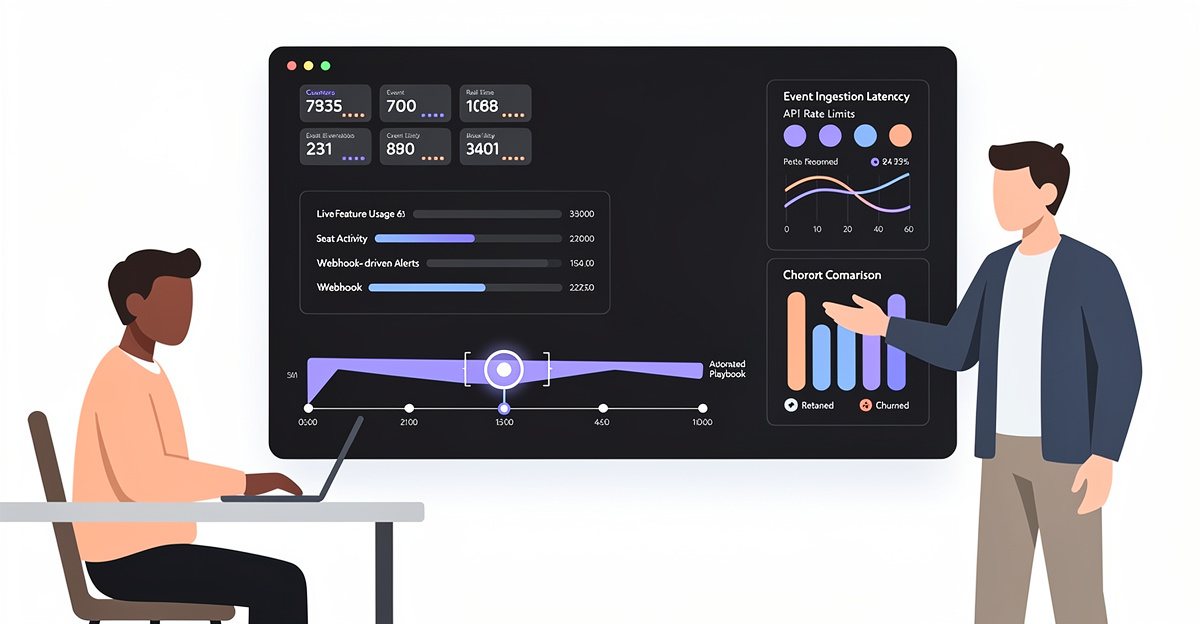
ChurnZero is built for mid-market SaaS teams that need earlier churn detection through real-time monitoring and predictive analytics. Its ChurnScore algorithm continuously updates account health using product usage, engagement patterns, and sentiment data. The point isn’t another static health score. It’s a configurable system that shifts as behavior shifts, so a sudden usage decline or engagement change shows up while there’s still time to act. ChurnZero also pulls usage stats, engagement metrics, and CRM details into a single command center. That matters when you need to review health across segments, accounts, and individual users, not just at the logo level.
The operational win is turning those signals into actions. ChurnZero supports automated playbooks and trigger-based workflows that fire on risk signals and milestones, backed by reminders and alerts. Teams can address issues in real time instead of waiting for QBR notes. Reported outcomes include a 60% reduction in churn and a 21% boost in gross revenue retention after implementing AI-driven tools. It can also scale coverage: one CSM can handle up to 13x more accounts using standardized playbooks and lifecycle automation.
ChurnZero starts at $1,500/month, and 63% of mid-market teams reportedly use it, per G2 Data. The tradeoff is onboarding time: teams say it takes effort to learn the full feature set.
How Feedvote solves this ChurnZero tells you who is at risk, but CS still needs to translate risk into product changes. Feedvote gives you a clean system to capture and organize customer requests so the “why are they unhappy” question gets answered fast. It also reduces noise by preventing duplicate asks from flooding your pipeline. If you want earlier churn signals plus clearer product follow-through, pair ChurnZero with a workflow that helps you close the feedback loop with action—and Feedvote is the tighter workflow for that.
Vitally in 2026: AI-Powered Customer Success That Only Works with a Truly Unified Customer Record
Your CSMs are working blind when customer data sits in five tools. Then leadership asks for “AI risk scoring,” and the model is fed stale, conflicting fields.
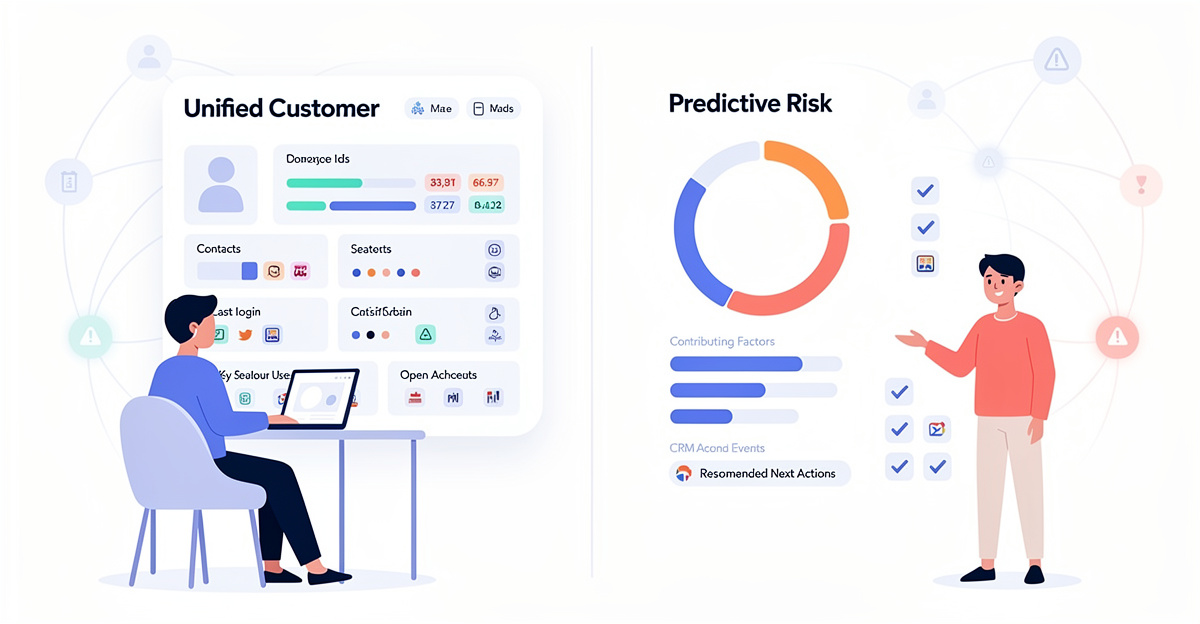
Vitally’s promise in a 2026 customer success stack is the same as any AI-driven CS tool: a unified customer view and predictive risk that helps you act before churn happens. But those outcomes are gated by one thing—integrated, high-integrity data. When sales, support, and CRM signals are merged into a single customer profile, teams can personalize outreach and handle issues faster because every touchpoint is visible in one place. The research is clear: siloed data blocks real-time personalization and slows response, because nobody can see the full customer story.[1][3][7]
Predictive risk is even more sensitive. AI can flag anomalies and forecast behavior only when it has complete, timely historical data across systems. Integrated datasets enable real-time alerts and more reliable recommendations, while fragmented inputs produce inaccurate forecasts and missed risks.[4][5][7] That’s the trade: Vitally’s AI can look smart in a demo, but in production it mirrors your data quality. If you have inconsistent identifiers, duplicated accounts, or missing event streams, you should expect noisy health scores and false positives.
How Feedvote solves this Feedvote reduces data chaos at the source: customer requests and feedback. It keeps feedback structured and deduplicated before it spreads across tools and teams. That improves the integrity of the signals you send into your CS platform and your AI layers. If you want cleaner inputs for unified views and risk flags, start by stopping duplicate requests and mismatched “same issue” threads—see preventing feature request duplicates in Linear. Compared to pushing raw feedback into a generic tracker and cleaning later, Feedvote is the better workflow because it enforces consistency upfront.
Userpilot as a 2026 Customer Success Tool: No‑Code Onboarding That Gets Users to Value Before They Churn

Onboarding breaks when every change needs an engineer and a release cycle. Early-stage CS teams then patch the gaps with 1:1 calls and guesswork.
Userpilot fits this stage because it lets you ship in-app onboarding without code: tooltips, interactive tours, checklists, and behavior-triggered guidance that react to what users actually do. Tooltips can be chained into walkthroughs, with progress bars that make the effort visible and completion more likely. Tours and checklists can be built from templates, then targeted by role, lifecycle stage, or behavior so different cohorts don’t get the same generic path. The big win is behavior-triggered sequences: show a modal, hotspot, or survey when a user hits a page or event, so the product explains itself at the moment of confusion. For retention work, Userpilot also supports feature discovery and upsell-style announcements, plus A/B testing to iterate on what keeps users engaged.
Deployment is designed for speed. You install a JavaScript snippet, then use the Chrome Builder Extension to design flows inside your UI. You can segment users (plan, activity) and publish immediately. Userpilot includes analytics to see activation, drop-offs, and goal performance, which matters when you’re trying to connect onboarding to feature engagement.
The tradeoff is focus: Userpilot is strong on the how of getting users through UI steps, and it’s built for a single app rather than enterprise-wide sprawl.
How Feedvote solves this Userpilot helps users learn features; Feedvote helps you decide which features and onboarding fixes to build next. Feedvote captures customer requests and ties them back to product work, so onboarding changes aren’t driven by anecdotes. It also reduces duplicate requests and keeps signal clean as volume grows. Pairing both gives you guided adoption plus a tighter feedback loop; see how to close the feedback loop with action.
Final thoughts
Bad customer success stacks fail the same way every time. They turn into a bloated enterprise graveyard of fields nobody trusts. Retention does not come from “more notes.” It comes from instrumented usage, captured feedback, and fast interventions that map to a renewal clock. Gainsight is the enterprise pick when you need health scoring tied to contracts and complex stakeholders. ChurnZero wins when you care about real-time risk and you cannot wait for a weekly export. Vitally is strong when you want a unified view plus predictive signals, and you are willing to fix identity hygiene. Userpilot is the early-stage weapon when adoption is the retention strategy and you need in-app control over activation. Pick the tool that matches your data maturity and renewal motion. Then enforce one rule: if it is not backed by events, it is not a “health score.”
Stop letting feedback rot in Slack threads. Start using Feedvote today to route customer feedback into your success workflows, tie it to usage, and boost retention.
Learn more: https://feedvote.app
About us
Feedvote is a customer feedback and public roadmap platform designed for modern SaaS teams. It centralizes feature requests, lets users vote, and keeps a public roadmap in sync with what you ship. It helps product and customer success share one source of truth, so feedback becomes trackable work instead of a pile of anecdotes. Use it to tag feedback by account, segment requests by ARR or plan, and close the loop with updates that reduce churn risk.