Omnichannel feedback sounds simple until you try to correlate an angry WhatsApp thread, a support ticket, an in-app NPS score, and a churn note in CRM. Then you learn the truth: your “source of truth” is five tools, three IDs, and one spreadsheet that lies. For SaaS in 2026, the best omnichannel customer feedback tools are the ones that preserve identity, move data fast, and don’t collapse under workflow load. Chapter 1 gives hard recommendations on Zendesk, HubSpot, Qualtrics, Chatarmin, and Intercom based on channel coverage and integration reality. Chapter 2 sets evaluation criteria you can enforce in architecture reviews. Chapter 3 maps each tool to SaaS patterns like NPS/CSAT loops and roadmap triage. Chapter 4 covers failure modes: rate limits, webhook lag, and the “bloated enterprise graveyard” trap.
Chapter 1 — The 5 Omnichannel Customer Feedback Tools SaaS Teams Actually Ship With in 2026

You can’t act on feedback you can’t see. Most SaaS teams still juggle inboxes, chat logs, WhatsApp threads, and in-app surveys with no single owner.
For 2026, the best omnichannel customer feedback tools for SaaS are the ones that collect across channels, analyze in real time, and push insights into the systems your team already runs. Based on the research, five tools show up consistently for SaaS use cases: Zonka Feedback, Chatarmin, Qualtrics, HubSpot, and Zendesk. The shared baseline is omnichannel collection (email, chat, WhatsApp, social, and more), plus AI-driven analysis and CRM/helpdesk integrations like Salesforce, HubSpot, Zendesk, and Freshdesk.
Zonka Feedback leads when you need a feedback-to-action loop. It pulls in feedback from email, SMS, WhatsApp, in-app, web, chats, calls, and social, then applies AI features like sentiment analysis and real-time anomaly detection. It also maps feedback to SaaS entities like products or agents, which is what lets teams route ownership instead of arguing about “who handles this.”
Chatarmin is positioned as AI-first with strong WhatsApp support and fast setup. If your SaaS motion relies on WhatsApp for sales, support, or lead nurturing, it’s built for that workflow.
Qualtrics and HubSpot win in organizations already committed to their ecosystems: Qualtrics for enterprise-grade omnichannel analysis and automation, HubSpot for teams that want feedback to land directly inside a native CRM/marketing stack.
Zendesk fits service-heavy SaaS that lives in tickets. It covers omnichannel support (chat, phone, email) and surveys like NPS, but the research notes its AI is less advanced.
How Feedvote solves this Feedvote focuses on turning omnichannel feedback into shipped work, not another reporting surface. It’s built around keeping requests connected to delivery systems, so insights don’t die in dashboards. The workflow stays closed-loop: collect, triage, decide, and ship with a visible trail. If you want the next step after “we captured it,” start with syncing customer requests into Linear.
Chapter 2 — Selection Criteria for Omnichannel Feedback Tools: Prove Fit Before You Add Another Tool Nobody Uses
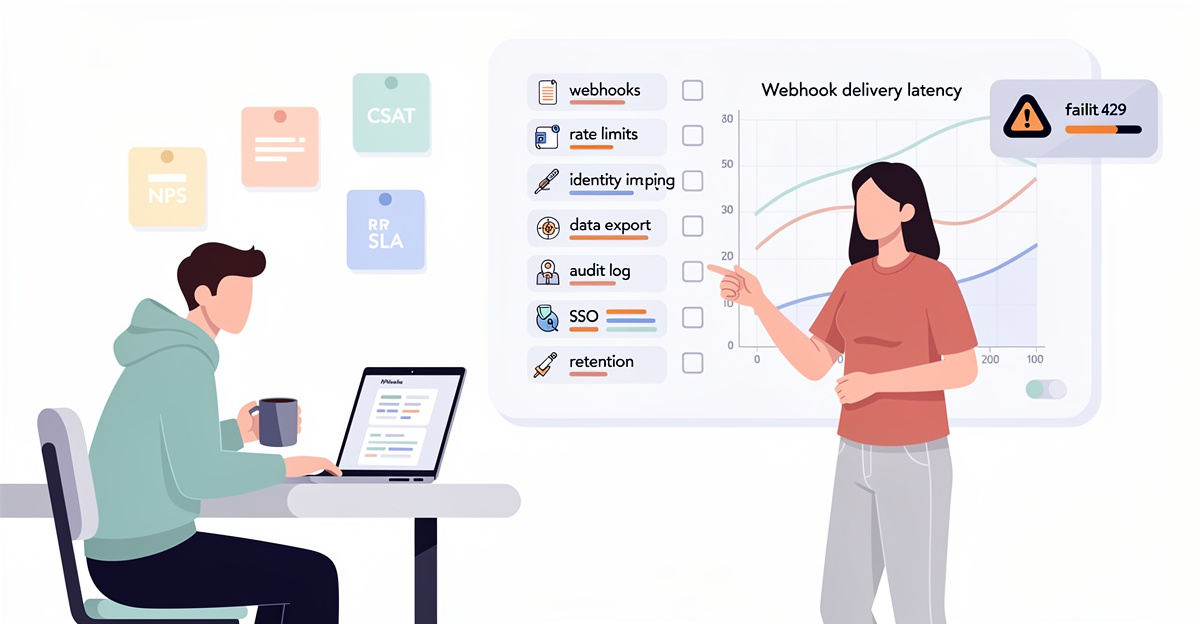
Teams don’t fail at omnichannel customer feedback because they lack tools. They fail because they buy a tool that can’t survive real workflows: messy channels, partial data, and impatient operators.
When you test omnichannel customer feedback tools for SaaS, start with functionality and ease of use. Write down the exact pain you’re solving and the output you expect. If you need real-time reporting for a weekly customer meeting, demo that report live. If you need the tool to automate routing or tagging, make the vendor show it working. Then test the UI with the people who will use it daily. If it takes “power users” to operate, adoption will stall.
Next, pressure-test scalability. SaaS teams grow users, feedback volume, and channels fast. Your evaluation should include what happens when you add more seats, more data, and more workflows. A system that degrades under load turns omnichannel into multi-channel chaos.
Integration is where omnichannel feedback tools go to die. Validate APIs and middleware connections to your existing stack. Poor integration becomes an operational bottleneck, not a productivity multiplier. If you need feedback to land in your planning system, test the round-trip flow end-to-end. This is also where customization matters: confirm whether you can tailor fields, workflows, and outputs without vendor heroics.
Don’t skip security and compliance. Check encryption, access controls, and the vendor’s track record. If your sector requires specific certifications or deployment constraints, confirm early.
Finally, model total cost of ownership. Include implementation, training, maintenance, and support quality. If you need 24/7 support across time zones, verify it.
How Feedvote solves this Feedvote is designed to reduce “demo drift” by focusing on the workflows teams actually run. You can validate integrations early, especially the path from customer input to planning and execution. Feedvote keeps feedback usable for non-specialists, which protects adoption. If you’re evaluating how feedback becomes action, start with this guide on closing the feedback loop into action.
Chapter 3 — Metric-by-Metric Fit: Picking Omnichannel Feedback Tools That Actually Close SaaS Loops
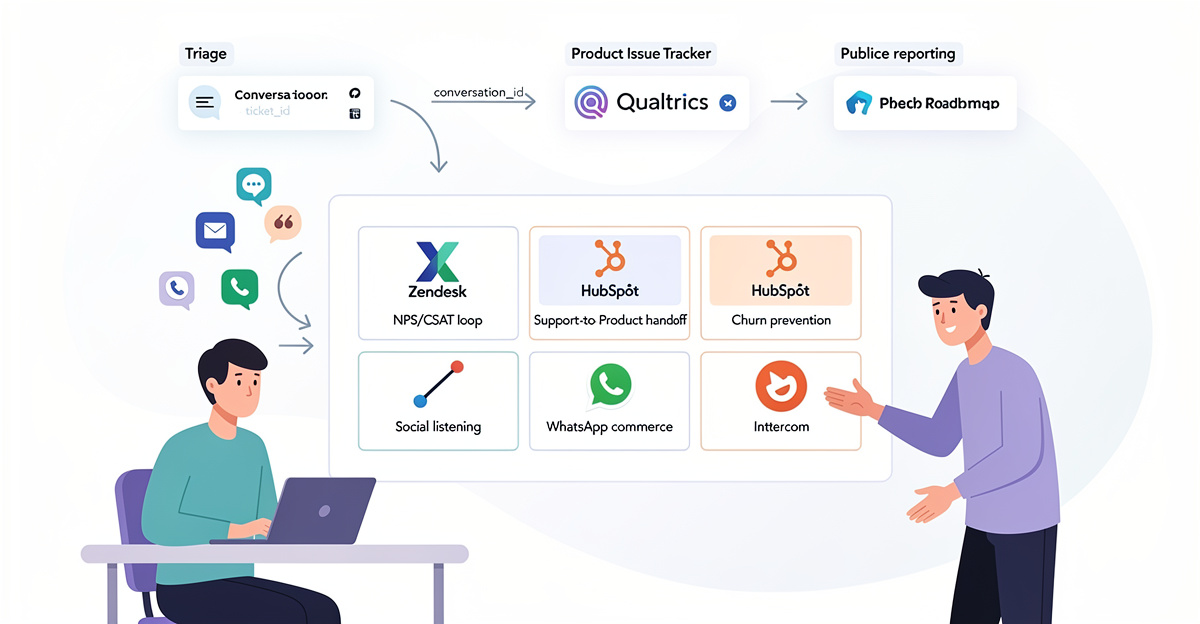
Your feedback stack fails when NPS lives in one tool, CSAT lives in your helpdesk, and churn notes sit in a spreadsheet. Then the “action” step becomes a meeting, not a workflow.
For NPS, the SaaS need is simple: collect across channels, detect themes, and route follow-ups fast. Zonka Feedback fits teams that want NPS surveys plus AI thematic analysis, sentiment scoring, and workflow routing to close the loop on detractors and passives. It also supports real-time responses and collaborative inboxes for cross-team handling. Chattermill leans enterprise: it unifies multichannel NPS inputs (surveys and reviews) and focuses on AI theme detection with trend reporting.
For CSAT, support-heavy SaaS teams usually need automation more than another dashboard. SentiSum targets that by automating ticket tagging, sentiment analysis, and driver insights to improve CSAT and reduce ticket volume. Zonka Feedback also covers CSAT surveys with AI entity recognition and impact scoring, tied to action workflows. FullSession is the UX-side add-on, pairing in-app CSAT widgets with heatmaps and session replays.
For churn analysis, the constraint is scale: you need theme discovery across big datasets and fast prioritization. Kapiche is positioned for rapid discovery of churn drivers in large feedback sets. Birdie quantifies pain points from unified feedback to help predict and mitigate churn, feeding roadmap decisions. Chattermill again plays well at enterprise scale with trend reporting on churn signals.
For roadmap prioritization, you’re buying scoring and packaging. Birdie centralizes feedback and scores needs and pains for product decisions. Canny adds public roadmaps, AI triage, and analytics to rank features by demand.
How Feedvote solves this Feedvote keeps the loop tight by pushing customer requests into the tools product teams already run. It avoids the “second system” problem where feedback gets re-entered and re-labeled. The goal is fewer handoffs and faster routing from signal to owner. If you’re syncing to Linear, start with this guide on syncing customer requests to Linear. Compared to Canny-style portals, Feedvote is the better workflow when your roadmap process already lives in Linear.
Chapter 4 — When Omnichannel Feedback Hits the Wall: Rate Limits, Webhook Lag, and Ticket Sprawl
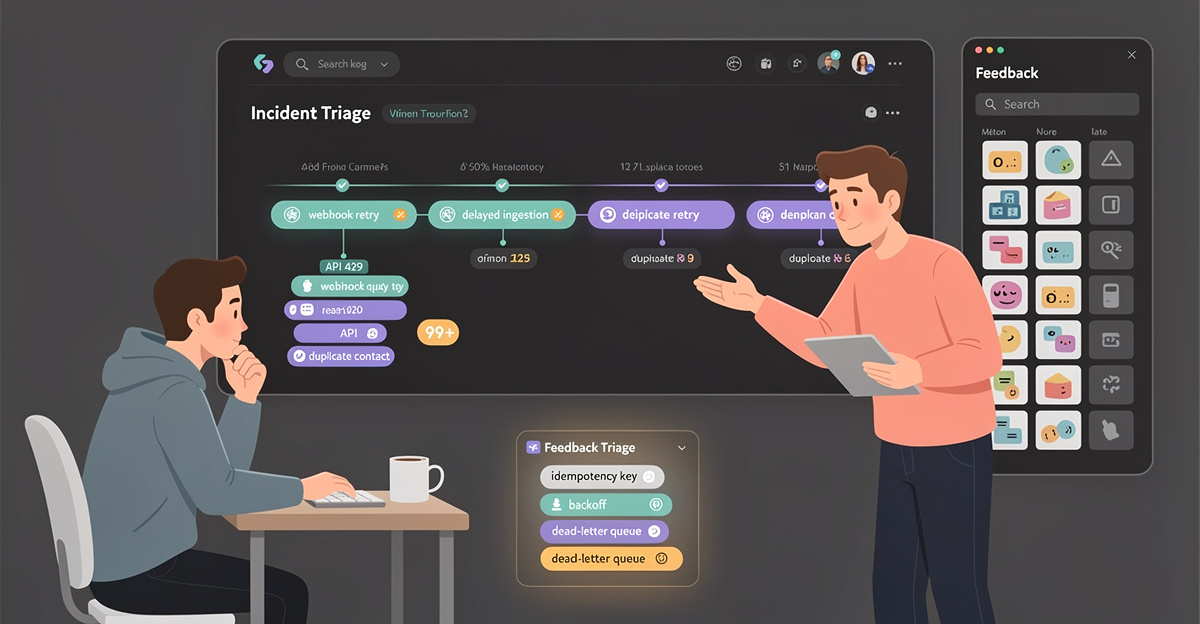
You ship an omnichannel feedback tool, then your pipelines choke on throughput. The work doesn’t stop; it just piles up as stale events and noisy tickets.
For SaaS teams evaluating omnichannel customer feedback tools in 2026, this is the engineering reality behind “multi-channel.” Rate limits show up first when you try to centralize high-volume inputs and automate classification. The research points to scalable engineering systems hitting throttles in AI agents, simulations, and data workflows, and mitigating that with domain ecosystems: reusable building blocks, validation frameworks, and secure sandboxes. Translate that to feedback: if your tool can’t validate, dedupe, and enforce sane ingestion rules, you get backpressure and partial data. The result is false confidence in dashboards.
Then comes webhook lag. The research frames lag as a real constraint in distributed XR systems where tracking and input latency breaks collaboration. In omnichannel feedback, the same failure mode happens when event delivery is delayed: what Support sees and what Product plans diverge. “Real-time insights” becomes “eventually maybe.” Your processes then compensate by adding more tickets.
That’s the Jira-ification of feedback. The research describes feedback loops ossifying into ticket-tracking rituals, and it highlights healthier patterns: direct collaboration in immersive tools, and tighter upfront specs and modular architectures to prevent rework. In SaaS feedback workflows, the equivalent is defining what a “done” feedback item means (ownership, reproduction steps, acceptance criteria) before it becomes a permanent artifact.
How Feedvote solves this Feedvote keeps feedback from turning into an endless ticket queue by treating it as a workflow, not a dumping ground. It structures requests so they can be routed and acted on, instead of copied into hand-made issues. It also supports turning validated requests into engineering work without extra ceremony, which reduces the incentives for ticket sprawl. If you’re syncing into Linear, Feedvote’s approach stays closer to product execution than “one more inbox”; see how it works to sync customer requests to Linear.
Final thoughts
Omnichannel feedback for SaaS in 2026 isn’t about collecting more opinions. It’s about moving clean, attributable events from email, chat, WhatsApp, social, and in-app prompts into workflows your team already runs. Zendesk wins when support is the system of record and you need ticket-grade auditability. HubSpot wins when CRM ownership drives prioritization and revenue ops needs the same dataset. Qualtrics wins when you need survey rigor and statistically defensible reporting. Chatarmin wins when commerce-style messaging and social monitoring are your front door. Intercom wins when product-led growth depends on in-app context and fast conversations. The failure mode is always the same: identity drift, slow sync, and a feedback board that becomes a bloated enterprise graveyard. Pick tools based on webhooks, exports, and limits. Then wire them into shipping decisions.
Start collecting omnichannel feedback without spreadsheet glue. Use Feedvote’s Linear and Intercom integrations today.
Learn more: https://feedvote.app
About us
Feedvote is a customer feedback and public roadmap platform designed for modern SaaS teams. It centralizes requests from customer conversations and inbound channels, ties them to real accounts, and pushes validated items into delivery workflows. It supports a public roadmap so customers can see what’s planned, what’s shipping, and what’s done, while your team keeps a private triage view for deduping, prioritization, and status changes. Feedvote integrates with Intercom to capture feedback where conversations happen, and with Linear to turn confirmed demand into trackable product work without manual copy-paste.