

Customer Feedback Management: The Complete Guide for 2026
Customer feedback management is the discipline of collecting user input, organizing it into patterns. and routing those patterns into product decisions that actually ship. Most teams collect feedback. Few turn it into outcomes. The difference sits in the system, not the volume.
A working feedback management practice connects three stages: capture, triage. and close-the-loop. Capture pulls signals from support tickets, sales calls. community channels. and direct submissions. Triage filters noise from signal and assigns weight. Close-the-loop tells users what happened to their request. Skip any stage and the system leaks trust.
The goal is not to gather more feedback. Teams already drown in it. The goal is to build a repeatable process that converts scattered input into prioritized work without burning hours on manual copy-paste or letting requests vanish into spreadsheets.
Why Customer Feedback Management Matters
Product teams ship faster when they know what to build. In practice, most teams operate on gut instinct padded with anecdotes from the loudest customers or the most recent sales call. Feedback management replaces anecdote-driven roadmaps with evidence-weighted ones.
The cost of ignoring this is measurable. Churn clusters around unmet expectations. Support volume grows when users cannot see progress on known issues. Sales cycles stall when prospects ask about features that are already planned but invisible. A public application roadmap solves visibility. A structured feedback system solves prioritization.
Revenue impact compounds over time. A single feature request might represent one vocal user. That same request submitted by 40 different accounts represents a retention risk. Without a system to count duplicates and surface patterns, the product team sees 40 separate tickets instead of one high-signal trend.
Product managers spend hours per week copying requests from Zendesk, Intercom. Slack. and email into whatever tool holds the backlog. Manual triage introduces errors. Requests get lost. Users never hear back. A customer feedback system automates the handoff and keeps attribution intact.
How Customer Feedback Management Works in Practice
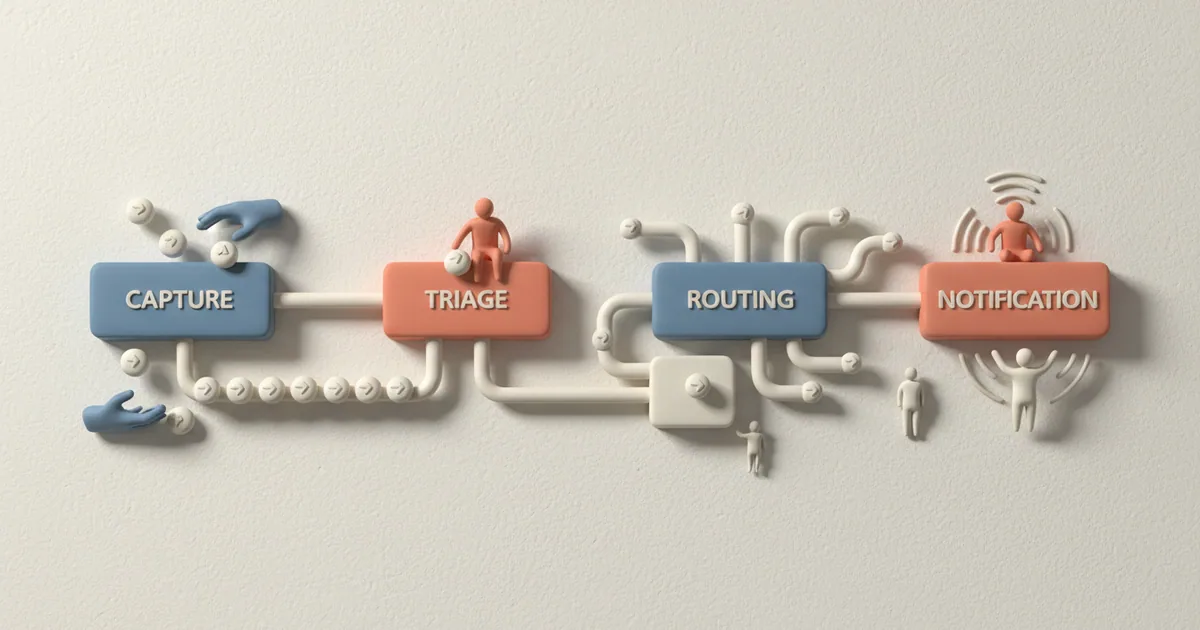
A working system has four components: a capture layer, a triage layer. a routing layer. and a notification layer.
Capture layer. Users submit feedback through a portal, widget. or integration. Embedded widgets in the app reduce friction. Email forwarding from support tools catches requests that arrive through tickets. API integrations pull signals from Slack or community forums. The key is deduplication. One feature request submitted through three channels should appear once with three sources linked.
Triage layer. Not every request deserves engineering time. Most teams use a two-stage process: first, someone on the support or product ops team reviews new submissions for spam. duplicates. and obvious non-starters. Second, approved requests enter a prioritization queue where product managers assign tags. link to existing themes. and estimate impact.
A customer service portal can handle the first stage automatically if it supports moderation workflows. The second stage usually requires human judgment. Some teams score requests by revenue weight. Others use vote counts as a proxy for demand.
Routing layer. Approved requests need to reach the backlog. For teams using Linear, this means creating issues automatically when feedback clears triage. Two-way sync keeps status updated. When an engineer moves the issue to "In Progress," the feedback portal reflects the change. Users see real movement without anyone copying text between tools.
The routing layer also handles segmentation. Different products or customer cohorts might need separate boards. A startup roadmap for a single-product company looks different from a multi-board setup serving enterprise clients with distinct feature sets.
Notification layer. Close-the-loop is where most systems fail. Users submit requests. Months pass. The feature ships. Nobody tells the user. A proper notification layer emails voters when their request moves from "Planned" to "Shipped." This turns passive requesters into engaged advocates.
Tradeoffs to Understand First
Every feedback system forces choices. Understanding the tradeoffs early prevents rework later.
Public vs. private boards. A public board lets anyone see what users request and vote. This builds community trust and reduces duplicate submissions. It also exposes your priorities to competitors. Private boards keep feedback internal but sacrifice the network effects of public voting. Most teams start private and go public once they have enough volume to curate.
Voting systems vs. weighted scoring. Vote counts are democratic. They surface popular requests. They also favor power users over new users and free accounts over paying customers. Weighted scoring assigns higher value to feedback from high-revenue accounts. The risk is over-indexing on a few loud customers while ignoring the long tail.
A practical compromise: use votes for discovery and weighted scoring for prioritization. Let the public board surface demand. Let the internal triage layer adjust priority based on business impact.
Tight integrations vs. flexibility. A feedback tool that syncs deeply with your issue tracker reduces manual work. It also locks you into that stack. A linear tracker integration means approved feedback becomes a Linear issue with one click. But if you switch to Jira later, migration costs rise. Most early-stage teams should optimize for speed and accept the switching cost.
Moderation burden vs. open submission. Allowing anonymous submissions increases volume and noise. Requiring login reduces spam but adds friction. Developer tools often allow anonymous feedback because developers hate unnecessary login flows. Consumer apps often require auth because bots flood open forms.
Where Customer Feedback Management Usually Goes Wrong

The failure modes are predictable.
Collecting without triaging. A feedback inbox with 2,000 unread items is worse than no inbox. It creates the illusion of customer-centricity while delivering none of the value. The fix is a triage SLA. Every submission gets a response within 48 hours, even if that response is "we've logged this and will evaluate it."
Prioritizing by volume alone. The most-voted feature is not always the most valuable. A request with 500 votes from free users generates less revenue impact than a request with 12 votes from enterprise accounts. The fix is layered scoring. Votes indicate demand. Revenue weight indicates impact. Strategic fit indicates alignment.
Never closing the loop. Users submit feedback because they want something to change. When nothing visibly changes, they stop submitting. Worse, they tell other users that feedback goes nowhere. The fix is automated notifications. When a request ships, email the voters. When a request gets rejected, explain why.
Treating feedback as a backlog. Feedback is input, not output. A feature request describes a problem, not a solution. Teams that copy user requests verbatim into the backlog ship features that match the request but miss the underlying need. The fix is synthesis. Group related requests into themes. Write the spec based on the pattern, not the individual ticket.
Ignoring internal feedback. Support teams hear the same complaints daily. Sales teams know which missing features kill deals. Internal feedback often has higher signal density than public submissions. The fix is a unified intake. Internal teams should submit feedback through the same system as external users.
Good feature request software handles all five failure modes by design.
Frequently Asked Questions
What is the difference between customer feedback management and a suggestion box?
A suggestion box collects input. Customer feedback management collects, triages. routes. and closes the loop. The difference is the system. Suggestion boxes accumulate dust. Feedback management systems produce prioritized work and notify users when that work ships.
How do I prioritize feedback when everything feels urgent?
Layer your scoring. Vote count measures demand. Revenue weight measures impact. Strategic alignment measures fit. A request that scores high on all three goes to the top. A request that scores high on votes but low on revenue might wait until you have capacity for community goodwill features.
Should I make my feedback board public or private?
Start private if you have low volume or a small user base. Go public once you have enough submissions to curate and enough team bandwidth to moderate. Public boards build trust and reduce duplicate submissions. They also invite competitors to watch your roadmap.
How do I connect feedback to my issue tracker without manual copy-paste?
Use a tool with native integration. For teams on Linear, a linear roadmap tool can sync approved feedback directly into issues. Two-way sync keeps status updated across both systems. When the issue moves to "Done" in Linear, the feedback portal updates automatically and notifies voters.