Manual feedback triage isn’t just annoying; it’s how requests get duplicated, priorities get political, and status updates turn into Slack archaeology. If you want a Linear feedback portal with 2-way sync in 2026, you need two things: a clean intake path and a reliable reconciliation loop back to the customer.
Chapter 1 sets up the portal structure so every submission lands in the right Linear team, project, and workflow state. Chapter 2 turns Linear’s form templates and automation into a pre-triage gate that tags, routes, and blocks garbage input. Chapter 3 covers the hard part: API and webhooks for 2-way sync, including idempotency, rate limits, and failure handling so you don’t create ticket storms. Chapter 4 adds roadmaps and changelogs without turning your process into a bloated enterprise graveyard that “needs a dedicated admin.”
Linear Feedback Portal Setup in 2026: Stop Letting Customer Requests Die in Slack Threads

You ship features off scattered inputs, then spend Fridays reconciling what customers actually asked for. Requests fall out of the funnel because they never become a tracked object in Linear.
A Linear feedback portal setup in 2026 starts with one decision: every customer request must enter Linear as an issue, with enough context to act on it. Linear doesn’t ship a “portal” product in the research provided, but it does give you the primitives to avoid orphaned requests: custom issue forms, agent-powered feedback capture, and integrations with support platforms.
If your feedback originates in support, use Linear’s Agent path. The research states Linear’s agent can review support transcripts and route product feedback and feature requests into Linear. It also supports connecting with Intercom and Zendesk, turning support tickets into issues “with a single click,” while analyzing full conversations and generating issue summaries, key details, and screenshots. That single step is the difference between “we heard you” and a backlog item with an owner.
If your feedback originates outside support, set up custom issue forms as the front door. The research confirms Linear supports customizable form templates with text inputs, dropdowns, checkboxes, and issue properties like priority, customer, and label groups. The goal is consistency: every request arrives pre-tagged, routed, and comparable. Don’t over-design the form yet. The next chapter will cover how forms and automation either filter noise or amplify it.
How Feedvote solves this Feedvote gives you an actual feedback portal front end, then syncs cleanly into Linear so requests don’t stall in “someone should file this.” It keeps the customer-visible intake separate from your issue tracker workflow. That means you get structured submissions without forcing users into internal tooling. For teams trying to build this with ad-hoc forms and integrations, Feedvote is the better workflow because it is purpose-built for portal intake while keeping Linear as the execution system.
Form Templates + Automation for Linear Portals: When Your Intake Is Sloppy, Your 2‑Way Sync Becomes Garbage
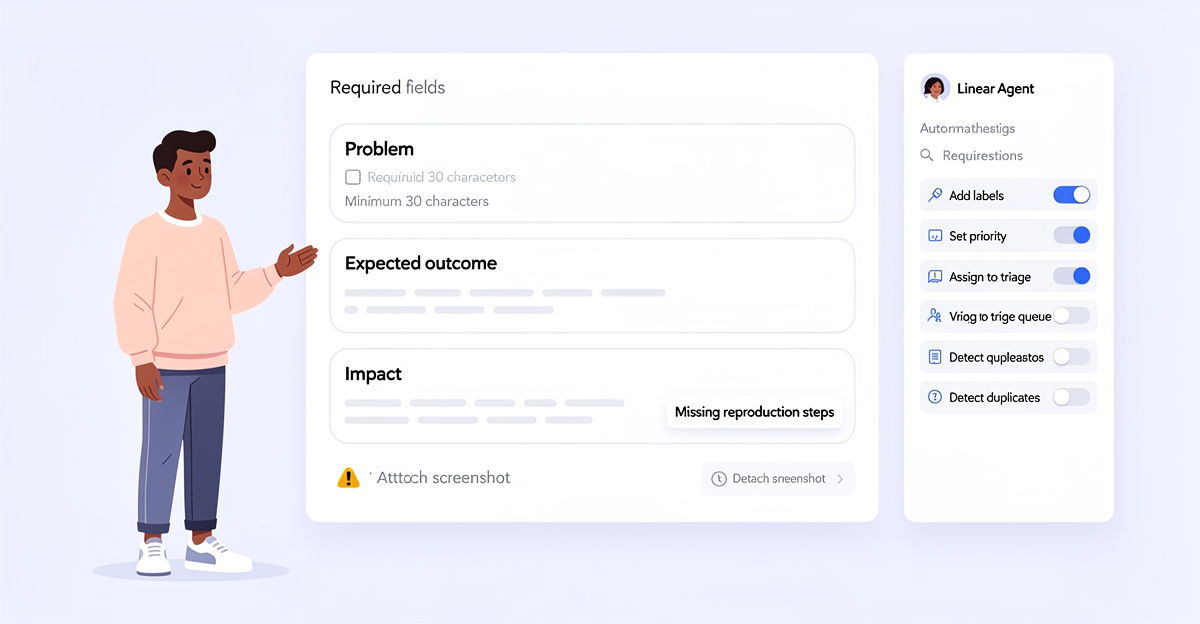
You can’t build a Linear feedback portal with 2-way sync if your intake form accepts chaos. Once inconsistent fields hit your system, the “sync” just copies the mess faster.
For a Linear portal in 2026, the form template is your first data contract. Use standardized templates with predefined fields and bindings so every submission has the same shape. That means consistent headers/footers, consistent field names, and consistent mappings before anything gets converted or routed. Then add conditional logic and validation. Show only relevant questions based on earlier answers. Require the fields you actually need. Enforce data types and error checks so junk gets blocked at the edge, not cleaned up in Linear later.
Downstream, aim for structured JSON outputs via webhooks. Map fields and transformations so payloads stay predictable. This avoids brittle CSV parsing and reduces the need for polling. You also get delivery logs for debugging when something breaks.
Automation is the second filter. Use workflow triggers to route submissions, apply conditional rules after submission, and kick off approvals when needed. If you map form fields directly into a structured database, you keep permissions tight and analysis clean over time.
Jotform and Fillout are strong at drag-and-drop form building and high-volume collection, especially when you need conditional logic and webhook transformations. The tradeoff is you still need a clean path into Linear and back out again, or you’ll end up maintaining glue logic.
How Feedvote solves this Feedvote enforces a structured intake so feedback arrives consistent before it ever touches Linear. It keeps the mapping stable so your portal doesn’t drift as the form changes. It also reduces manual triage by turning submissions into clean, actionable records. That makes 2-way sync a workflow, not a cleanup project.
Linear 2‑Way Sync in 2026: Webhooks, Idempotency Keys, and Fewer “Why Is This Duplicated?” Incidents
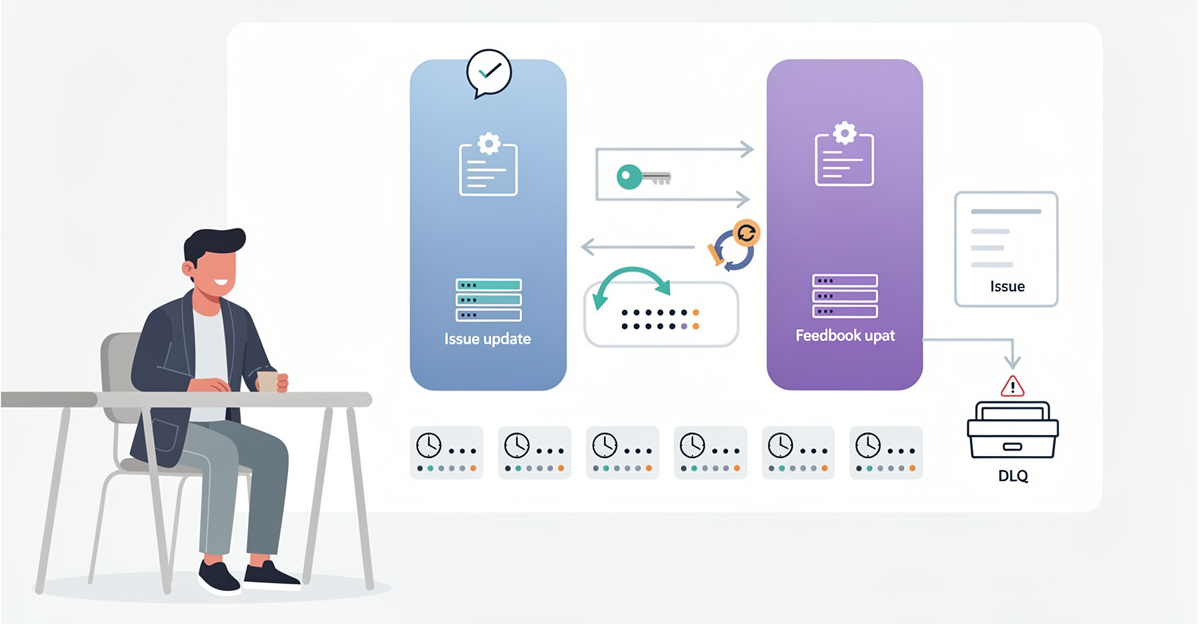
Your first 2-way sync will “work” until it doesn’t. Then a retry storm hits and your Linear project fills with duplicate issues, stale states, and phantom updates.
When you wire a Linear feedback portal to external systems via APIs and webhooks, you’re signing up for at-least-once delivery. Providers retry on timeouts and network failures. If your handler isn’t idempotent, “retry” becomes “duplicate mutation.” In a 2-way sync, that’s worse, because the duplicate can bounce back and forth between systems.
Build the sync around deterministic writes. Use a stable external event identifier (event.id, order_id, or an idempotency key) and store it with a unique constraint. Your webhook handler should verify the signature (HMAC-SHA256 over HTTPS), check if the event was already seen, and return 200 if it was. Then persist the raw event as pending, ACK immediately (200/202), and process asynchronously. This avoids the synchronous anti-pattern where slow downstream work triggers provider retries. Heavy logic belongs behind a queue (RabbitMQ, SQS) and should use upserts so replays are safe.
Retries still happen. Make your receiver retry with exponential backoff and jitter, and push poison messages to a DLQ. Assume providers may retry for days, so keep ACK latency under 5–10 seconds. To handle missed events, add reconciliation: a periodic CRON sweep (for example, every 6 hours) that re-pulls and reconciles state for eventual consistency.
How Feedvote solves this Feedvote is built for 2-way sync workflows where retries are normal, not exceptional. It treats incoming events as replayable and deduplicated, so Linear doesn’t get spammed when delivery isn’t perfect. Feedvote also keeps a clean separation between “receive” and “process,” so you can ACK fast and handle heavy work later. The result is a Linear feedback portal that stays stable even when the network doesn’t.
Roadmaps + Changelogs for a Linear Feedback Portal: Close the Loop Without Shipping a Second Product
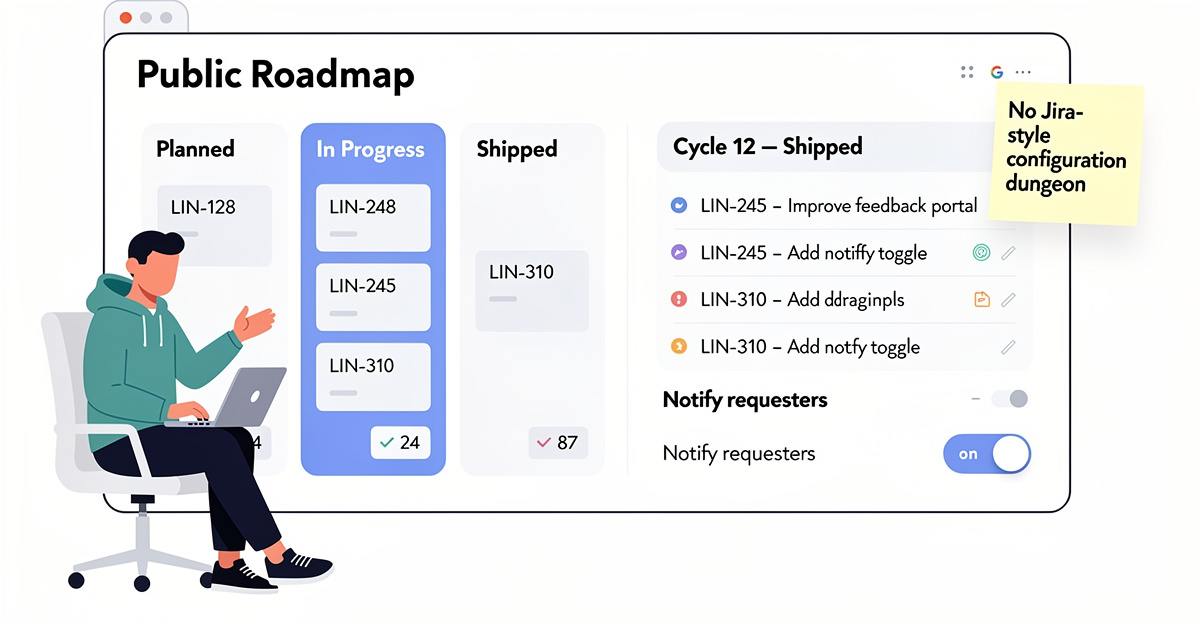
Your Linear feedback portal fails when “what’s happening with my request?” becomes a weekly support loop. It also fails when your roadmap turns into a second product your team has to maintain.
A public roadmap is only useful if it closes the loop. Keep it tight: show items users actually requested or voted on, not every internal initiative. Tie each roadmap card back to the original feature request so users can see the thread from feedback to delivery. Use segmentation so different user groups see different roadmap views, based on their interests or tier. Tools like Canny can run public or private roadmaps and notify users when requested features ship. That cuts manual follow-ups and keeps the portal honest.
Changelogs have the same constraint: signal over noise. Don’t document every minor tweak. Focus on changes that hit real workflows or address repeated feedback themes. Group related updates so users scan once and move on. Use clear formatting that reads like a publication, not a dump of commits. When you ship a feature driven by feedback, plan in-app messages as part of the release. That makes the update discoverable and pushes users back toward the portal.
Integration matters, but only if it reduces admin work. Roadmaps and changelogs should connect to your delivery workflow through tools like Jira, Asana, or Slack, so updates don’t require duplicate data entry. Treat the feedback system like a product: version changes, keep compatibility in mind, and track adoption so you don’t accumulate process debt.
How Feedvote solves this Feedvote keeps your roadmap and changelog tied to the same feedback objects you sync with Linear. That means users see progress and outcomes without you maintaining parallel records. You can stay focused on the requests that matter, instead of publishing internal noise. Compared to stitching together a roadmap tool plus manual updates, Feedvote is the better workflow because the portal, updates, and sync stay connected.
Final thoughts
A Linear feedback portal with 2-way sync in 2026 is a systems problem, not a UI problem. You need clean intake so requests don’t become unowned issues. You need strict form templates so customers give you reproducible input instead of vibes. You need automation so triage is a queue, not a meeting.
Then you need real 2-way sync. That means webhooks, idempotency keys, and retry paths. If you skip those, you’ll create duplicate issues, lose status updates, and train customers to ask in Slack anyway.
Finally, ship the outward-facing layer. Roadmaps and changelogs should be projections of reality. They should reflect Linear state with minimal manual edits. If your “portal” requires weekly gardening, you built a second backlog. Keep feedback as the source, keep Linear as execution, and keep the sync loop deterministic.
Set up your Linear feedback portal with Feedvote's 2-way sync today and start triaging customer requests directly.
Learn more: https://feedvote.app
About us
Feedvote is a customer feedback + public roadmap platform. It replaces Canny and Productboard for teams who want less bloat, lower cost, and faster workflows. It integrates deeply with Linear, but works as your source of truth for feedback.
Manual “link the issue and update the user” workflows don’t scale. Feedvote keeps feedback items, votes, and requester context in one place. It syncs to Linear so engineers stay in Linear. It also syncs back so customers see real status, not stale promises. That’s how you avoid the bloated enterprise graveyard problem where your portal becomes a second Jira.