
Manual roadmap updates are not “busywork.” They are a data integrity bug. The moment your public roadmap drifts from Linear, customers see dates you never committed to and statuses nobody can defend. The reflex is to “just expose Linear.” That move leaks triage notes, internal ownership drama, and security context that should never leave your walls.
The fix is a privacy-first sync that treats Linear as the execution layer, not the marketing surface. Chapter 1 breaks down the three integration shapes that actually work: API code, iPaaS, or ETL. Chapter 2 shows privacy patterns that prevent comment and label leakage. Chapter 3 forces a hard decision on data ownership and one-way flow so you stop building a bidirectional mess. Chapter 4 gives an implementation plan for two-speed sync: fast internal updates, slower sanitized external updates with auditability.
Choosing the Right Sync Engine for Linear Roadmap Data (API vs iPaaS vs ETL) Without Creating a Privacy Incident
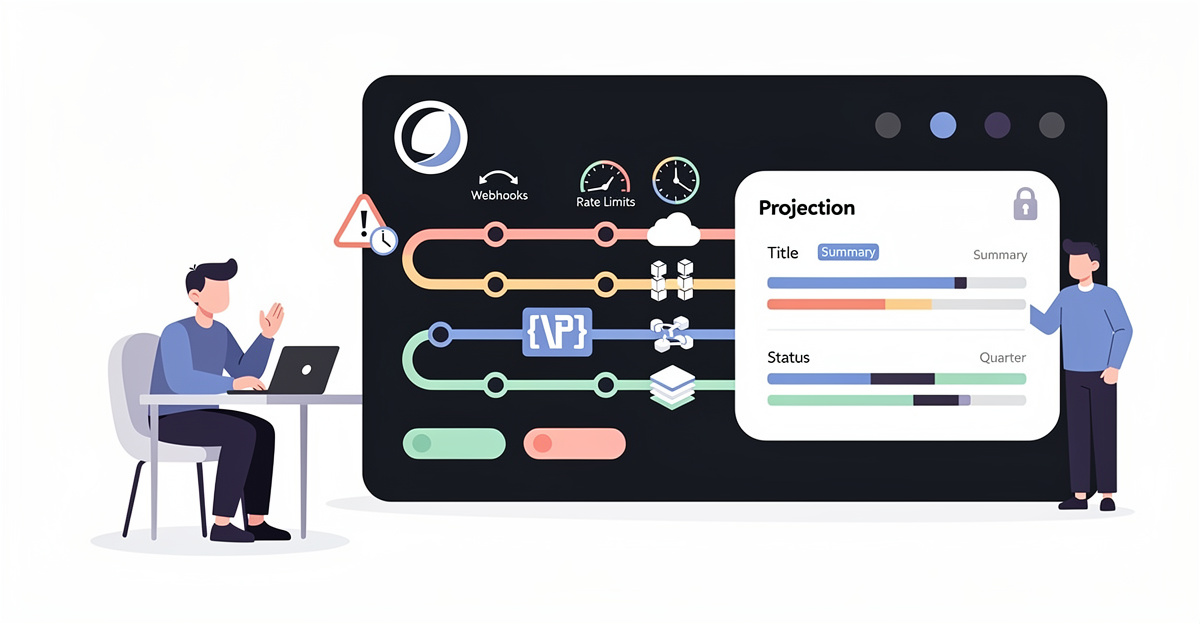
Your Linear roadmap is already a source of truth. The moment you sync it, you also create a new failure surface: broken pipelines, silent drift, and accidental oversharing.
For a linear roadmap sync (source → destination, minimal branching), ETL/ELT is the right default engine. It’s built for structured data movement and transformations, like pulling NetSuite data into a warehouse for reporting. ETL reshapes data before loading, which fits fixed schemas and batch windows, but it’s rigid when the source changes and you must redeploy pipelines. ELT flips the order: load raw data into a warehouse, then transform using warehouse compute, which fits analytics-heavy roadmapping and scales with the warehouse model. If you try to do this with raw API integrations, you get maximum control and maximum maintenance. You also own monitoring, retries, and all the little edge cases that show up after month two.
iPaaS sits in the middle, but it’s a different job. iPaaS is for process automation across apps, especially real-time triggers. If your “roadmap sync” is actually orchestrating workflows—creating downstream tasks, updating CRM fields, firing notifications—iPaaS is a fit. If you stretch iPaaS into complex reporting pipelines, you tend to end up with brittle scripts and vendor lock-in. This is where teams accidentally create “tool sprawl”: ETL for data, iPaaS for workflows, plus a few custom APIs nobody wants to own.
The failure modes are predictable. Schema drift breaks ETL/ELT. Brittle scripting breaks iPaaS. Governance blind spots break all of it if you don’t centralize monitoring. The right choice is the one where you’re willing to own the failure.
How Feedvote solves this Feedvote avoids turning your sync engine into a privacy hazard. It gives you a product feedback and roadmap workflow that doesn’t require pushing internal Linear details everywhere. You keep Linear as the working system, and expose only what you intend to share externally. If you need a two-way motion, start with Linear feedback portal 2-way sync and then decide where ETL, iPaaS, or APIs belong behind it.
Sync Less, Leak Less: One-Way Projections, Field Allowlists, and Comment Blackholes for Linear Roadmaps
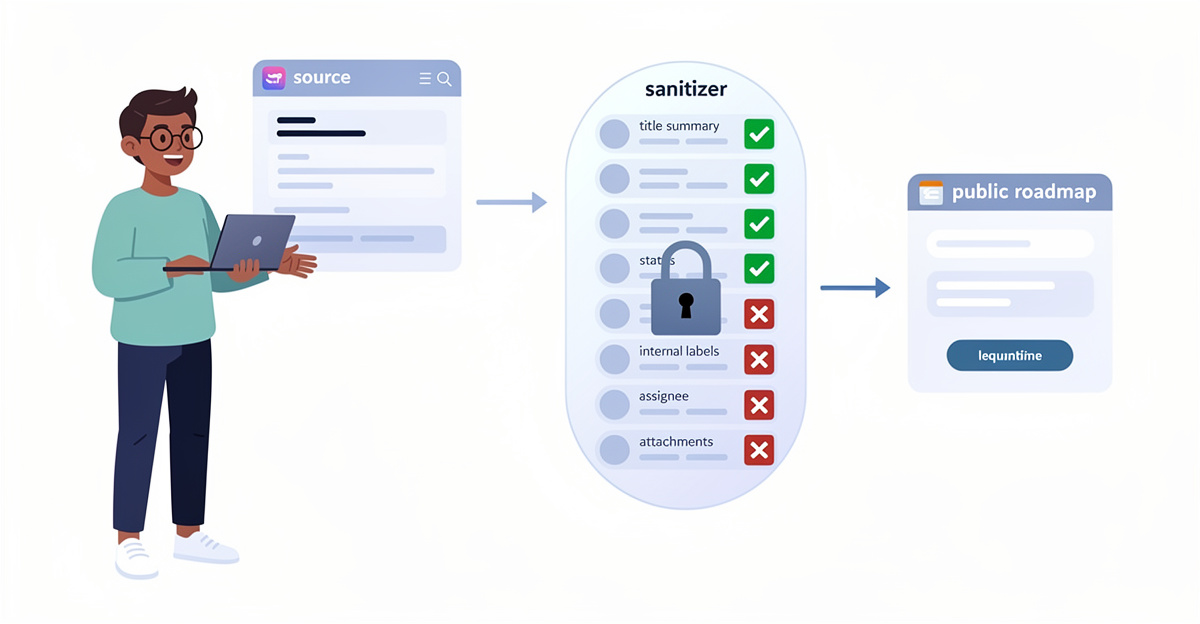
Your Linear roadmap data is full of things customers should never see. The moment you sync “everything” into a shared system, you’ve already lost internal privacy.
Privacy-preserving sync patterns are about shrinking the data surface area before anything leaves your walls. In local-first architectures, data primarily lives on the client, with background sync for eventual consistency across devices. That model maps cleanly to B2B SaaS roadmap sharing: treat Linear as the internal system, then publish a controlled projection outward.
One-way projection means you only ever push a subset of roadmap data out. The server or external system should never receive the full internal record. This is enforced by fine-grained access control at the sync boundary, such as custom sync servers or GraphQL resolvers that apply permissions. The point is simple: if the remote side never receives sensitive fields, it can’t expose them.
Field allowlists make this explicit. You define the approved fields, block everything else, and sync only those. Some implementations use custom endpoints that pull/push changes incrementally for permitted fields. The same sources also call out encrypting local databases post-revocation to reduce extraction risk if a device is compromised. In practice for Linear roadmap sync, allowlists stop “helpful” additions like internal tags or customer names from silently propagating later.
Comment blackholes drop the noisy, dangerous metadata: comments, logs, and annotations. Local-first sync approaches also emphasize client-side merges without shipping full edit histories upstream. For roadmaps, this keeps internal debates and decision trails from becoming someone else’s searchable artifact.
How Feedvote solves this Feedvote is built for publishing a customer-safe view of your roadmap without exposing internal Linear details. You control what gets surfaced, instead of syncing your whole internal object model. That matches one-way projection and field allowlists in a product workflow, not a custom integration project. See how this plays out in practice in the guide to a public roadmap in Linear.
Pick the Roadmap Source of Truth Early, or Your Linear Sync Becomes a Privacy and Conflict Trap
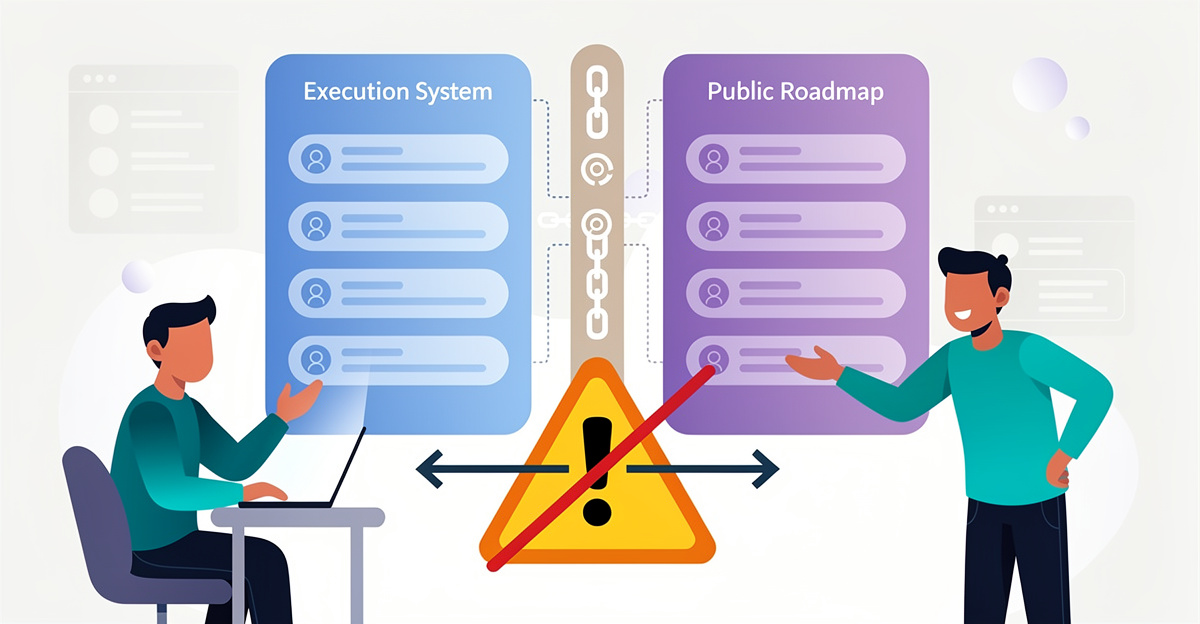
If two systems can edit the same roadmap fields, you will ship contradictions. The sync won’t just drift; it will fight itself and overwrite decisions.
For Linear roadmap sync without breaking internal privacy, data ownership is the first non-negotiable. Every synced entity needs a declared master system, or you create the “two-headed monster”: multiple tools claim authority, changes bounce back, and nobody trusts what they see. In classic ops stacks, teams assign customers to a CRM, items to an ERP like NetSuite, and inventory to a WMS. The same rule applies to roadmap data. Decide what Linear owns (issues, status, target dates) and what an external portal or CRM owns (requester identity, account tier, deal context). When conflicts happen, the owner wins by definition.
If you ignore ownership, you end up arguing about conflict strategies under pressure. Some teams default to last-write-wins or timestamp rules. Others force a manual queue for sensitive domains like finance or customer records. Those are valid mechanisms, but they are second-order decisions. First-order is making sure only one side is allowed to be “true” for a given field.
Unidirectional sync is the simplest escape hatch. One-way flows avoid loops and duplication because there is no reverse overwrite path. That lines up with privacy-preserving patterns from the prior chapter: you can project a safe subset outward while keeping internal context private.
How Feedvote solves this Feedvote is designed around a clear ownership split. Feedvote can own the external-facing feedback object while Linear remains the owner of delivery work and internal discussion. That lets you keep sync direction intentional, instead of accidentally turning it bi-directional. If you do need two-way behavior, you still define which fields are writable on each side, so privacy and authority stay predictable. See the workflow in this guide to a Linear feedback portal with 2-way sync.
Two-Speed Roadmap Sync for Linear: Pick an Integration Platform, Lock Compliance, and Ship a Plan That Stays Maintainable
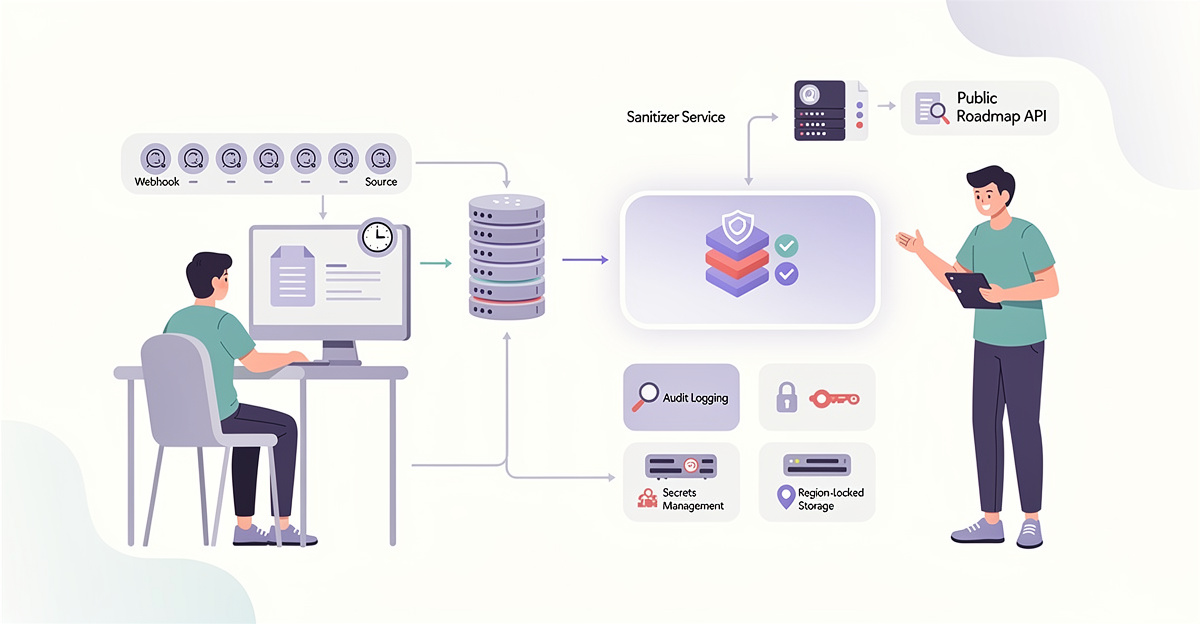
Your Linear roadmap data won’t stay private if every team builds “just one more” connector. Your sync won’t stay reliable if it depends on hero debugging and tribal knowledge.
After you’ve picked a source of truth, you need two-speed sync that matches B2B privacy constraints: sub-60-second CDC for operational views, and batch ELT for analytics. Integrate.io is built for this split. It supports sub-60s CDC plus batch ELT, with native bidirectional Salesforce sync and auto-schema mapping, without you managing infrastructure. SnapLogic can also run real-time streaming plus ETL/ELT, with a low-code designer and pre-built “Snaps,” and it supports Git-based CI/CD for pipeline changes. Fivetran is strong on near-real-time CDC and automated schema handling, but transformations are more limited and often pushed to dbt. Boomi covers lots of connector cases and hybrid needs, but the research here calls out less emphasis on sub-minute latency. When you evaluate any of these, keep the privacy goal in view: your “fast lane” should carry only what operations need, not internal notes.
Compliance controls are not optional in B2B SaaS sync. The platforms cited commonly cover SOC2, ISO, HIPAA, and GDPR, plus SSO/SAML, RBAC, and audit-friendly logs. SnapLogic and Fivetran call out governance features like lineage and monitoring dashboards. SAP Integration Suite and IBM options are associated with enterprise SLAs like 99.95% uptime. Your implementation plan should treat these as configuration work, not a later security project.
A maintainable rollout is a 6–8 week, phased build: week 1 discovery and speed definitions; weeks 2–3 PoC with connectors and latency tests; weeks 4–5 compliance setup (RBAC, dashboards, alerts, log audits); week 6 orchestration and CI/CD; weeks 7–8 parallel run and monitoring with SLAs.
How Feedvote solves this Feedvote keeps your customer-facing roadmap and feedback workflow separate from your internal Linear details. You can sync what customers should see without copying sensitive internal fields into external tools. That means your integration platform handles data movement, while Feedvote handles controlled exposure. If you’re considering a direct portal-to-Linear approach, Feedvote’s workflow is the safer default; see the Linear feedback portal 2-way sync guide.
Final thoughts
Roadmap sync fails in two predictable ways. First, it drifts, because humans do not do perfect double entry. Second, it leaks, because “just expose Linear” exports triage and internal context with it. A privacy-first Linear roadmap sync fixes both by treating external visibility as a projection, not a mirror.
Pick an integration shape you can operate. API services give control. iPaaS gives speed. ETL gives history. Then lock down the data contract with a strict allowlist and a separate public summary field. Decide ownership per field and keep the flow one-way for execution state. Finally, run a two-speed pipeline so internal work stays real-time while external updates are delayed, sanitized, and auditable.
If your public roadmap can change without an audit trail, you do not have a roadmap. You have a promise generator. Build the projection. Keep triage private. Ship the work.
Set up your Linear roadmap sync with Feedvote today—keep internal conversations private while customers see real progress.
Learn more: https://feedvote.app
About us
Feedvote is a customer feedback + public roadmap platform. It replaces Canny and Productboard for teams who want less bloat, lower cost, and faster workflows. It integrates deeply with Linear, but works as your source of truth for feedback.